![{$v[2]社交图标](/uploadfile/202607/d48465068ed5887bb35bf9ccf663eb12.png)
![{$v[2]社交图标](/uploadfile/202607/a3a97666a9e164435479a8cb5039711a.png)


Machine Tool Fixtures Current Application and Its Future
time:2026-07-17
Source:
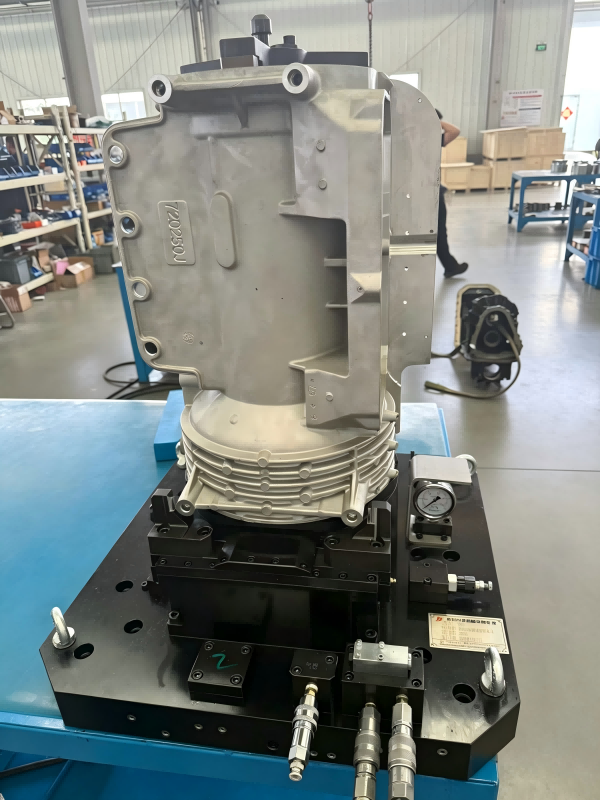
Fixtures first emerged in the late 18th century. With continuous advances in science and technology, fixtures have evolved from simple auxiliary tools into a complete range of process equipment.
1. Current Status of Machine Tool Fixtures
Statistics from the International Institution for Production Engineering Research reveal that workpieces produced in small-to-medium batches with diverse varieties account for approximately 85% of all workpiece types. Modern manufacturing requires companies to frequently upgrade and renew product lines to meet market demands and stay competitive. Nevertheless, most manufacturers still rely heavily on conventional dedicated fixtures. Factories with medium production capacity typically stock thousands, even nearly ten thousand sets of dedicated fixtures.Additionally, manufacturers engaged in multi-variety production need to replace 50% to 80% of their dedicated fixtures every 3 to 4 years, while only 10% to 20% of the fixtures actually suffer from wear and tear.In recent years, the adoption of CNC machine tools, group technology, Flexible Manufacturing Systems (FMS) and other advanced machining technologies has imposed new requirements on machine tool fixtures, as listed below:
Enable quick and convenient setup for new product launches to shorten production lead time and cut manufacturing costs;
Accommodate clamping of workpieces with similar geometric characteristics;
Deliver high-precision clamping performance for precision machining equipment;
Develop new-style fixtures compatible with all modern manufacturing technologies;
Adopt clamping units powered by hydraulic stations and other power sources to reduce labor intensity and boost productivity;
Promote higher standardization of machine tool fixtures.
2. Development Trends of Modern Machine Tool Fixtures
The development of modern machine tool fixtures mainly falls into four core directions, represented by standardization and flexibility.
(1) Standardization
Standardization and generalization of machine tool fixtures are closely interconnected. China has formulated national standards for fixture parts and components, including GB/T2148~T2259-91, alongside standards for various universal fixtures and modular fixtures.Standardization of machine tool fixtures facilitates commercialized fixture production, shortens production preparation cycles, and reduces overall manufacturing costs.
(2) Flexibility
Analogous to the flexibility of machine tools, fixture flexibility refers to a fixture’s capacity to adapt to variable process parameters through adjustment and reassembly. Key variable process parameters include operation types, production batch sizes, and workpiece geometry and dimensions.Major flexible fixture types include modular fixtures, universal adjustable fixtures, group fixtures, module-based fixtures and CNC fixtures.To cater to multi-variety, small-and-medium batch production in the modern machinery industry, expanding fixture flexibility, transforming non-detachable dedicated fixtures into detachable structures, and developing adjustable fixture designs represent the primary development priorities for fixtures today.
